
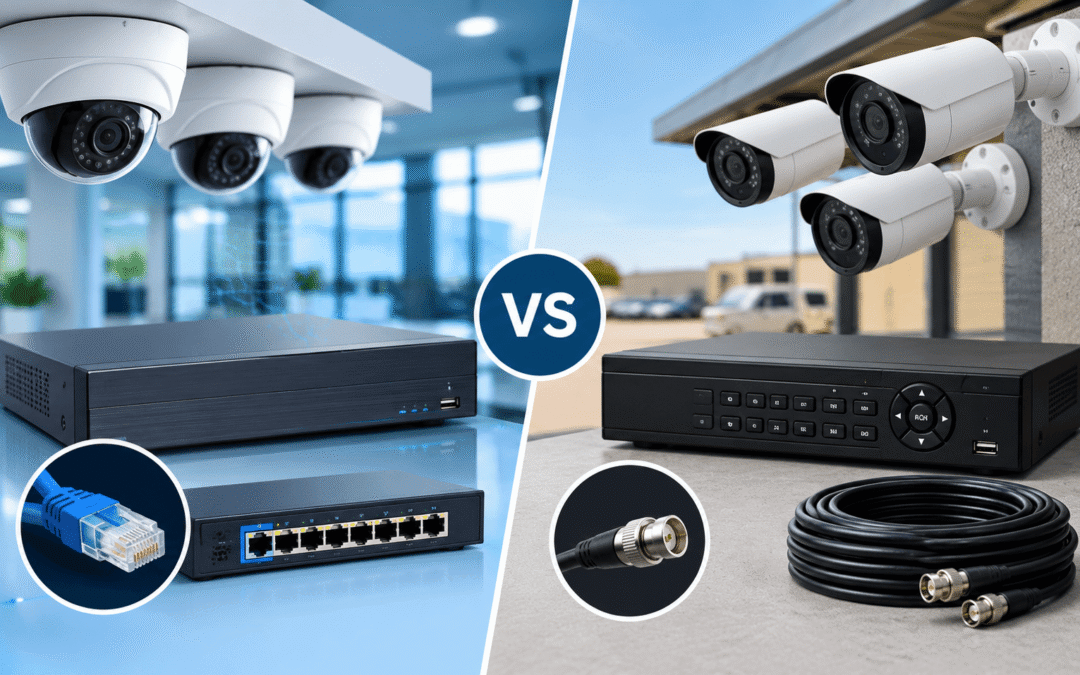
When a business installs security cameras, the recorder affects image quality, wiring, expansion, and daily management. An NVR works with internet protocol cameras that process video before sending it across a network. A DVR receives raw footage from analog cameras and processes it at the recorder. Neither choice fits every property. This NVR vs. DVR security systems comparison explains the practical differences in performance, installation, cost, storage, and remote access.
Tampa businesses considering security camera installation can use this guide to evaluate existing wiring and future needs. The right recorder should support the required cameras, coverage, retention period, viewing features, and available budget at every entrance, exit, and parking area.
NVR vs. DVR Security Systems
An NVR is generally better for a new installation needing higher resolution, flexible camera placement, and easier expansion. It uses network cameras and often carries video, power, and data through Ethernet cabling.
A DVR may be practical when a property already has working coaxial cable and compatible analog cameras. Reusing that infrastructure can reduce disruption and initial costs.
Choose according to the complete camera system rather than the recorder alone. Camera type, cable routes, required detail, storage, and future growth should guide the decision.
What Is an NVR Security System?
A network video recorder receives encoded digital video from IP cameras. Each camera processes the footage before transmitting it over the network.
The NVR records, stores, and organizes those video streams. Authorized users can review live or saved footage through a connected monitor, computer, or supported mobile application.
Many systems use Power over Ethernet switches or built-in PoE ports. One Ethernet cable can then carry network data and electrical power to a compatible camera.
Advantages of an NVR
NVR systems can provide:
- High-resolution digital video
- Flexible camera placement across a network
- Power and data through one compatible cable
- Support for advanced camera features
- Straightforward expansion within system limits
- Remote viewing through supported software
These features often make an NVR security system suitable for new offices, retail properties, warehouses, and multifamily buildings.
Possible Limitations
An NVR installation may require new Ethernet cabling, network switches, and configuration. These requirements can increase the initial project cost.
Network capacity also matters. Poor planning can create bandwidth problems or unreliable video connections.
Not every IP camera works with every recorder or feature. Confirm compatibility before combining equipment from different product lines.
What Is a DVR Security System?
A digital video recorder typically connects to analog cameras through coaxial cable. The cameras send unprocessed video signals to the DVR.
The recorder converts those signals into digital footage for storage and viewing. Cameras usually need separate power connections unless the system uses compatible power-over-coax technology.
DVR equipment remains useful for properties with existing analog infrastructure. A business may upgrade cameras and the recorder without replacing every cable.
Advantages of a DVR
DVR systems may offer:
- Reuse of existing coaxial wiring
- Lower costs for some basic installations
- Familiar operation for existing users
- Reliable local recording
- Modern analog high-definition camera options
- A practical path for gradual upgrades
A DVR security system can make financial sense when current cables remain usable, and the property does not need network-camera features.
Possible Limitations
Coaxial cabling is less flexible for network-based expansion. Each camera normally needs a direct cable run back to the recorder.
Analog systems may provide fewer intelligent features than modern IP platforms. Available resolution and analytics depend on the recorder, camera, and signal format.
Separate camera power can add cables and power supplies. Long cable routes may also make future changes more difficult.
NVR vs. DVR Security Systems: Main Differences
NVR systems work with IP cameras that process video before sending it to the recorder. They commonly use Ethernet cables, which can carry both power and data through PoE. NVRs often support higher resolutions, advanced video features, and flexible expansion.
DVR systems connect mainly to analog cameras through coaxial cables. The recorder processes the incoming footage, while cameras usually require separate power. DVRs may suit properties with usable analog wiring and limited expansion plans.
The main differences include:
- Camera compatibility: NVRs use IP cameras, while DVRs use analog cameras.
- Cabling: NVRs commonly use Ethernet, while DVRs rely on coaxial wiring.
- Video processing: NVR cameras process footage; DVR recorders handle processing.
- Expansion: NVR systems are often easier to expand across a network.
- Best application: NVRs suit new systems, while DVRs can support existing analog setups.
Actual features depend on the cameras, recorder, manufacturer, and software selected.
Which System Has Better Image Quality?
NVR systems commonly support higher-resolution IP cameras. This can provide greater detail when viewing faces, vehicles, entrances, or transaction areas.
However, resolution alone does not guarantee useful footage. Lens selection, camera placement, lighting, frame rate, and compression also affect the recorded image.
Modern DVRs can support high-definition analog cameras that provide clear footage for many applications. They may meet the needs of smaller properties and existing systems.
Define what the footage must show before selecting a resolution. Wide-area awareness requires a different camera layout than identifying details at a doorway.
FAQ
Can an NVR Work With Analog Cameras?
Not directly in most cases. An encoder or hybrid recorder may connect certain analog cameras to a network-based system. Compatibility should be confirmed first.
Can a DVR Use IP Cameras?
A standard DVR usually supports analog cameras. Some hybrid recorders accept both analog and IP models within specified limits.
Is an NVR Better for 4K Cameras?
NVRs commonly support high-resolution IP cameras, including compatible 4K models. Recorder channels, bandwidth, and storage must support the selected settings.
Can Existing Coaxial Cable Be Reused?
Usable coaxial cable can often support a compatible DVR upgrade. Its condition, connectors, length, and required video format need evaluation.
Which Recorder Is Better for a Growing Business?
An NVR often provides more flexible network expansion. Businesses should confirm channel limits, storage capacity, licenses, and network resources before purchase.
Choose a Recorder Around Your Security Needs
The right NVR vs. DVR security systems choice depends on existing cabling, camera requirements, image detail, expansion plans, and budget. A site assessment can reveal which platform offers practical long-term value and reliability.
Contact Affordable Lock & Security for help planning a dependable surveillance system for your Tampa-area property.