
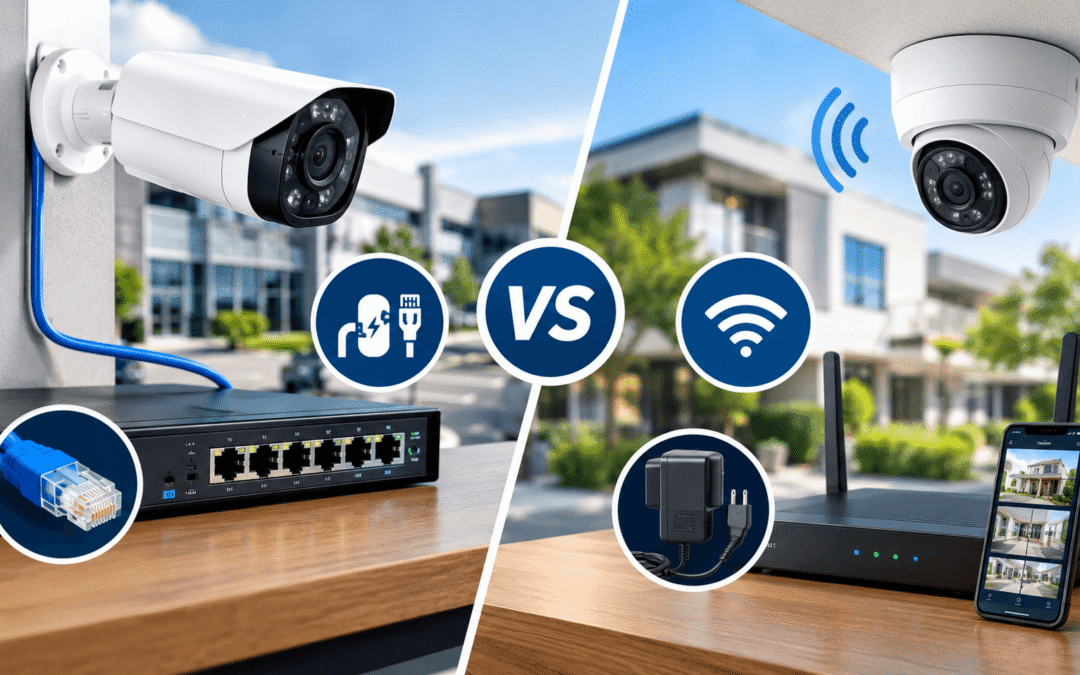
A security camera is only useful when it maintains a dependable connection and records the details your business needs. PoE cameras receive power and network data through an Ethernet cable. WiFi cameras send video wirelessly but still require electricity unless they use batteries.
For most permanent commercial installations, PoE offers greater reliability and simpler centralized power management. WiFi provides more placement flexibility where running network cable is difficult.
This PoE vs. WiFi security cameras guide compares installation, performance, image quality, security, costs, and maintenance. Tampa businesses planning security camera installation can use these factors to select cameras suited to their property, network, and daily operations during every scheduled recording period.
PoE vs. WiFi Security Cameras: Quick Answer
Choose PoE cameras for dependable video transmission, continuous recording, and permanent coverage. They often suit offices, warehouses, retail stores, parking areas, and multifamily properties.
Choose WiFi cameras when cable installation is difficult or the camera location may change. They may work well in smaller spaces with strong wireless coverage.
PoE is generally the better choice for a complete commercial surveillance system. WiFi can still support selected areas when installation flexibility matters more than a wired connection.
What Is a PoE Security Camera?
A PoE security camera uses Power over Ethernet technology. One compatible Ethernet cable carries video data and electrical power between the camera and network equipment.
The cable usually connects to a PoE network switch or an NVR with built-in PoE ports. The camera sends digital footage across the wired network for recording and viewing.
Because each camera has a physical connection, performance does not depend on the strength of a wireless signal. This can support consistent recording in busy network environments.
Benefits of PoE Cameras
PoE cameras offer several practical advantages:
- Stable wired data transmission
- Power and video through one cable
- Support for continuous recording
- Centralized power management
- Easier use of backup power
- Strong support for high-resolution footage
- Predictable performance across permanent locations
A central uninterruptible power supply can support the network switch, recorder, and connected cameras during a short outage. The available runtime depends on the equipment and battery capacity.
Limits of PoE Cameras
Every camera needs an Ethernet route. Installing cable through finished walls, high ceilings, concrete, or outdoor areas may increase labor.
Standard Ethernet also has practical distance limits. Large properties may require additional switches, fiber connections, or another network design.
PoE cameras are less convenient to move because relocating one may require a new cable. Careful placement before installation prevents unnecessary changes.
What Is a WiFi Security Camera?
A WiFi security camera sends video through a wireless network instead of an Ethernet data cable. Most models still need a nearby electrical outlet or wired power source.
Battery-operated cameras avoid fixed power wiring, but they require charging or battery replacement. Their recording behavior may also differ from continuously powered cameras.
WiFi performance depends on signal strength, interference, network capacity, and distance from the access point. Building materials can also weaken the connection.
Benefits of WiFi Cameras
WiFi cameras may provide:
- Flexible placement within wireless range
- Less network cabling
- Faster setup in accessible locations
- Easier relocation
- Useful coverage for smaller properties
- Practical options for temporary monitoring
These cameras can solve placement problems where running Ethernet is disruptive or impractical. A network assessment should still confirm reliable coverage.
Limits of WiFi Cameras
Wireless cameras can lose connectivity when signals are weak or crowded. Walls, metal shelving, nearby networks, and other devices may cause interference.
Adding many high-resolution cameras can place heavy demand on the wireless network. Business traffic and camera traffic may compete for available capacity.
An outlet near the mounting location may be easier to provide than Ethernet, but it can restrict placement.
PoE vs. WiFi Security Cameras: Which Has Better Image Quality?
Both connection types can support high-resolution video. The camera sensor, lens, lighting, compression, bitrate, and recording settings determine actual image quality.
However, a wired PoE connection often handles high-bitrate footage more consistently. This matters when several cameras record detailed video at the same time.
A WiFi camera may reduce quality or lose frames when network conditions decline. Performance depends on the camera and wireless system.
Businesses should define what each camera must capture. Monitoring general activity requires less detail than identifying a face or reading vehicle information.
PoE vs. WiFi Security Cameras: Which Costs Less?
WiFi cameras may have lower installation costs when a property has strong wireless coverage and nearby power. Extra access points or electrical work can reduce those savings.
PoE systems may cost more initially because of Ethernet cabling, switches, and professional labor. Their stable connection and centralized power can provide better value for permanent commercial coverage.
Request an itemized estimate that includes cameras, cabling, switches, storage, mounting, configuration, and training. Compare total system costs rather than camera prices alone.
FAQ
Do PoE Cameras Work Without the Internet?
Many PoE systems can record locally without internet service. Remote viewing and cloud features may become unavailable until the connection returns.
Do WiFi Cameras Need a Power Cable?
Most WiFi cameras need fixed electrical power. Battery models do not, but they require charging and may use event-based recording to preserve energy.
Can WiFi Cameras Record Continuously?
Some models can record continuously when they have constant power, sufficient network capacity, and compatible storage. Features vary by product.
Can PoE and WiFi Cameras Use the Same Recorder?
Some recorders support both when the cameras use compatible protocols. Confirm channel limits, licensing, and feature support before combining equipment.
Which Camera Type Is Better for Outdoor Use?
Either can work outdoors if the model has a suitable environmental rating. PoE often provides a more dependable connection across permanent exterior locations.
Select Cameras for Reliable Coverage
The right PoE vs. WiFi security cameras choice depends on cable access, wireless coverage, recording needs, placement, and budget. PoE usually suits permanent business systems, while WiFi helps with selected difficult locations.
Contact Affordable Lock & Security for help designing a reliable security camera system for your Tampa-area property.