
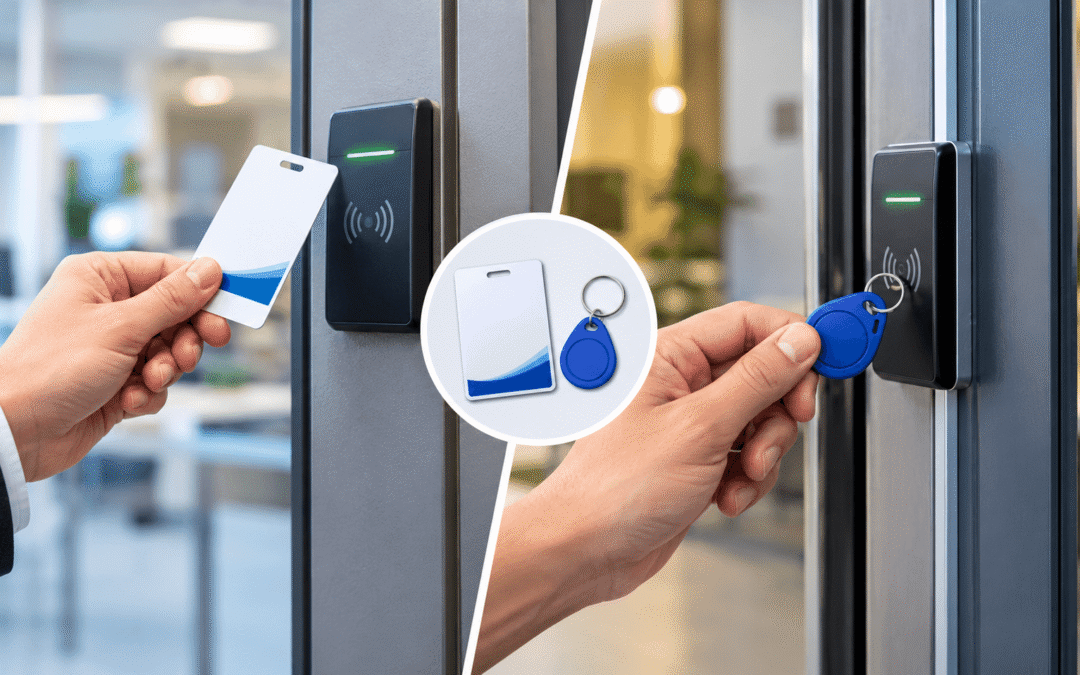
Employees need a quick, reliable way to enter the workplace without managing traditional keys. Key cards and fobs both provide convenient electronic entry, but they serve different priorities. Cards fit easily inside wallets and can display company branding or employee details. Fobs attach to key rings and usually handle daily wear more effectively.
This key card vs. key fob access control guide compares cost, convenience, durability, security, and management. Tampa businesses planning an access control system can use these differences to choose suitable credentials. The best option should match employee routines, workplace conditions, entry volume, identification needs, and the existing reader technology installed at each controlled door across the property.
Key Card vs. Key Fob Access Control
Choose key cards when employees need visible identification, photo badges, or credentials that fit inside a wallet. They often suit offices, schools, hotels, and medical facilities.
Choose key fobs when durability and everyday convenience matter more than printed identification. They often work well for warehouses, apartment communities, small offices, and mobile teams.
Both credentials can provide similar access permissions when they use compatible technology. The physical format creates the biggest difference for most users.
How Does Key Card Access Work?
A key card access system uses encoded cards and electronic readers. Users present or tap a card near the reader to request entry.
The reader sends credential data to the access controller. If the card has permission at that door and time, the system releases the lock.
Administrators can assign each card to one person. They can also limit access by building, door, day, or schedule.
Benefits of Key Cards
Key cards provide several practical advantages:
- Fit inside wallets or badge holders
- Support names, photographs, and company branding
- Work with badge clips and lanyards
- Allow quick credential replacement
- Suit organizations requiring visible identification
- Store easily in organized card inventories
Businesses can use one card for identification and entry when their systems support both purposes. This reduces the number of items employees must carry.
Possible Drawbacks
Plastic cards can bend, crack, or wear when carried loosely. Printed details may also fade after frequent handling.
Employees sometimes leave cards in wallets beside other contactless cards. Presenting several credentials together can prevent the reader from identifying the correct one.
Cards may also feel inconvenient for employees who already carry keys but do not wear identification badges.
How Does Key Fob Access Work?
A key fob access system uses small electronic credentials designed for a key ring. Users hold the fob near a compatible reader.
Like a card, each fob carries a unique credential number. The controller checks that number against its permissions before allowing entry.
Fobs come in several shapes, colors, and technologies. The reader and management platform must support the selected format.
Benefits of Key Fobs
Key fobs can offer:
- Compact construction
- Convenient key-ring attachment
- Good resistance to bending
- Simple color coding for departments
- Fast presentation at readers
- Suitability for users who do not wear badges
Their small format makes them easy to carry. Employees can keep a fob with the keys or tools they already use each day.
Possible Drawbacks
Fobs provide little space for names, photographs, or instructions. They are not a substitute for visible employee identification.
Their size can also make them easier to misplace. A lost fob should be reported and disabled promptly.
Some inexpensive casings may crack under heavy impact. Businesses should select credentials appropriate for the workplace environment.
Key Card vs. Key Fob Access Control: Main Differences
| Feature | Key card | Key fob |
| Carrying method | Wallet, badge clip, or lanyard | Key ring or clip |
| Printed identification | Ample space for names and photographs | Very limited space |
| Durability | Can bend or wear | Usually resists bending |
| Storage | Easy to stack and organize | Requires more storage space |
| Branding | Supports detailed printing | Limited branding area |
| Daily convenience | Useful for badge-wearing staff | Useful for key-carrying staff |
| Replacement | Easy to print and issue | Easy to program and attach |
| Access permissions | Managed through the system | Managed through the system |
This key card vs. key fob access control table shows that both formats can perform the same basic entry function. User habits and workplace conditions usually guide the choice.
Which Credential Is More Secure?
The shape of a credential does not determine its technical security. A card and fob using the same technology may provide similar protection.
Credential technology, reader configuration, system management, and employee habits matter more. Older formats may be easier to duplicate than modern encrypted options.
Ask the installer which credential technologies the proposed readers support. Businesses should also understand how administrators issue, update, audit, and deactivate credentials.
- Assign each credential to one person
- Disable missing credentials immediately
- Remove access when employment ends
- Review permissions regularly
- Avoid sharing credentials
- Investigate repeated denied-entry events
A well-managed commercial access control platform provides more control than an untracked supply of mechanical keys.
FAQ
Are Key Fobs More Secure Than Key Cards?
Not necessarily. Security depends mainly on credential technology, encryption, reader configuration, and system management rather than physical shape.
Can Key Cards and Fobs Use the Same Reader?
Yes, when both use technology supported by that reader. Always confirm frequency, format, and platform compatibility before ordering replacements.
What Happens When a Card or Fob Is Lost?
An administrator can deactivate the missing credential and issue another one. Prompt reporting prevents the lost item from remaining active.
How Long Do Access Credentials Last?
Service life depends on construction, handling, and environment. Cards may bend or fade, while fob casings can crack after repeated impact.
Can Employees Share a Key Card or Fob?
Sharing makes access activity harder to trace. Assigning one credential per user supports clearer records and easier permission management.
Choose Credentials That Fit Daily Work
The right key card vs. key fob access control choice depends on identification needs, carrying habits, durability, compatibility, and budget. Some businesses may benefit from offering both formats.
Contact Affordable Lock & Security for help planning electronic access credentials and door security for your Tampa-area business.