
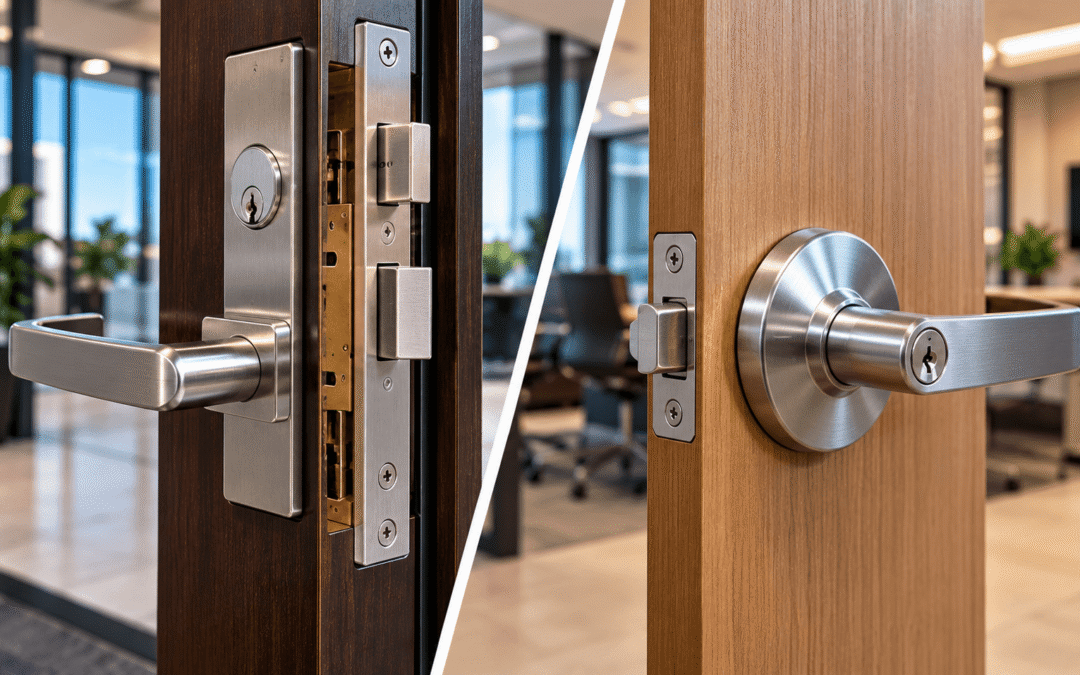
A mortise lock contains a rectangular lock body fitted inside a pocket cut into the door. A cylindrical lock uses a compact mechanism installed through a round hole. This structural difference affects strength, appearance, installation, maintenance, and price. Mortise locks often suit busy commercial entrances and properties needing durable hardware. Cylindrical locks work well for many offices, closets, and interior rooms where straightforward installation matters.
This mortise lock vs. cylindrical lock guide explains how both designs function and where each performs best. Local Tampa business owners can use the comparison to select practical hardware based on traffic, security needs, door construction, budget, and long-term use before arranging professional installation.
Mortise Lock vs. Cylindrical Lock
A mortise lock places its main case inside a deep pocket in the door edge. The case can combine the latch, deadbolt, and other functions within one durable assembly.
A cylindrical lock fits through a round hole drilled across the door. Its latch slides into a smaller opening along the door edge.
For frequent traffic and demanding commercial use, a mortise design may provide greater durability and more function options. For offices and standard interior openings, a cylindrical design usually offers simpler installation and lower upfront costs.
How Does a Mortise Lock Work?
A mortise lock uses a reinforced metal case recessed into the door. The handle spindle, keyed cylinder, latch, and optional deadbolt connect to this case.
Turning the lever retracts the latch. Locking the door prevents the outside handle from operating, depending on the selected function. Users can still leave from inside when the hardware is configured for that purpose.
Advantages of Mortise Locks
Mortise locks offer several practical qualities:
- Strong internal construction
- Good performance under frequent use
- Multiple locking functions
- Replaceable internal components
- Compatibility with many commercial door styles
- A professional, integrated appearance
Their larger case distributes operating forces across more internal hardware. This construction makes them a common choice for heavily used entrances.
Points to Consider
Installing the case requires a precisely sized pocket. Incorrect cutting can weaken the door, affect alignment, or prevent smooth operation.
Mortise hardware also costs more than many cylindrical options. However, its serviceable components can support long-term use when properly maintained.
Replacing an existing mortise assembly may require compatible dimensions and trim. A technician should inspect the current preparation before ordering new hardware.
How Does a Cylindrical Lock Work?
A cylindrical lock passes through a large round hole drilled across the door. A separate edge bore holds the latch.
The outside and inside levers connect through the central chassis. Turning an authorized lever retracts the latch and opens the door.
This compact design suits many standard doors. Manufacturers offer passage, privacy, keyed entry, storeroom, and other functions for different rooms.
Advantages of Cylindrical Locks
Cylindrical locks can provide:
- Faster installation on prepared doors
- Lower initial hardware costs
- Simple replacement
- Many available lever styles
- Suitable options for light or moderate traffic
- Familiar operation for users
Pre-drilled commercial doors often accept standard cylindrical dimensions. This compatibility can reduce labor when a business replaces similar existing hardware.
Points to Consider
Not every cylindrical product has the same strength or duty rating. Residential-grade hardware may not withstand repeated commercial use.
Businesses should select hardware designed for the opening’s traffic and purpose. A busy exterior entrance needs different equipment than a private office.
The door and frame must also align correctly. A quality lock may still bind if loose hinges or a failing closer prevent the latch from entering the strike.
Mortise Lock vs. Cylindrical Lock: Direct Comparison
| Feature | Mortise lock | Cylindrical lock |
| Main mechanism | Large case inside the door edge | Compact chassis through the door |
| Door preparation | Deep rectangular pocket | Round cross bore and edge bore |
| Typical cost | Usually higher | Usually lower |
| Installation | More complex and time-consuming | Faster on a prepared door |
| Traffic level | Often selected for heavy use | Common for light or moderate use |
| Function options | Wide range of configurations | Standard commercial functions |
| Repair approach | Many internal parts are serviceable | Complete replacement is often simple |
| Appearance | Integrated commercial profile | Familiar lever-and-rose design |
This mortise lock vs. cylindrical lock comparison reflects common applications. Product grade, door condition, and installation quality also affect performance.
Which Lock Provides Better Security?
A mortise design often provides greater strength because its substantial case sits inside the door. Models with integrated deadbolts add another locking point.
However, lock type alone does not determine security. The cylinder, strike, frame, hinges, fasteners, and door material must support the complete opening.
A commercial-grade cylindrical model can provide suitable protection for many offices and controlled interior rooms. Choosing the correct grade matters more than buying an unfamiliar design solely because it appears stronger.
Affordable Lock & Security offers high-security commercial door locks for Florida businesses that need an upgraded door solution.
FAQ
Is a Mortise Lock Stronger Than a Cylindrical Lock?
Mortise locks generally have larger internal cases and often suit heavy traffic. Still, product grade, door strength, and correct installation influence total security.
Can You Replace a Cylindrical Lock With a Mortise Lock?
Yes, but the door needs significant new preparation. A professional must cut a deep pocket and confirm the door can accept the hardware.
Can a Mortise Lock Be Repaired?
Many mortise lock components can be serviced or replaced. Repair suitability depends on the model, damage, age, and availability of compatible parts.
Are Cylindrical Locks Suitable for Exterior Doors?
Commercial-grade cylindrical locks can suit some exterior doors. The selected hardware should match expected traffic, exposure, and security needs.
How Can I Identify My Existing Lock?
A rectangular faceplate and large internal case usually indicate mortise hardware. A round rose around the lever often indicates a cylindrical design.
Choose Hardware That Matches the Door
The right mortise lock vs. cylindrical lock decision depends on traffic, door preparation, security goals, and budget. Matching the hardware to the opening supports dependable operation without unnecessary expense.
Contact Affordable Lock & Security for help selecting and installing commercial door locks for your Tampa-area property.